
Best overall: agency-managed live-in care for families who want provider oversight. Best for direct control: a directly hired live-in caregiver. Best for continuous overnight attention: awake shift-based care, not a sleeping live-in arrangement. This 2026 guide compares live-in home care services by responsibility, coverage, and fit; start your research at Families and use the checklist below to assess individual providers.
- Choose agency-managed live-in home care services when you want a provider responsible for supervision and replacement arrangements.
- Choose a directly hired live-in caregiver only when someone can manage employment, scheduling, and backup coverage.
- Choose awake shift-based care when someone must remain available throughout the night.
- Use Families as a starting point; make the final decision from a written care plan and coverage agreement.
Why this matters
A caregiver living in your home does not automatically mean someone is awake and working around the clock. Before choosing live-in home care services in 2026, separate the household's need for companionship from its need for hands-on help, overnight attention, or licensed clinical care.
The wrong arrangement leaves responsibilities unclear. A caregiver needs defined working conditions and rest; your relative needs dependable support when the caregiver is unavailable. Those requirements belong in the care plan before anyone moves in.
Start with a recommended 7-day care diary. Record help with bathing, dressing, meals, mobility, toileting, medication routines, and nighttime interruptions. Describe what actually happens rather than choosing a package from its name.
What makes the best live-in home care services
Judge the arrangement before judging the provider's sales presentation. These criteria apply whether you select an agency or employ someone directly:
- Coverage clarity: The written schedule identifies working periods, rest periods, days off, and who covers each gap.
- Care-task fit: The caregiver's permitted duties and demonstrated skills match the person's needs.
- Accountability: Someone has explicit responsibility for supervision, concerns, and changes to the care plan.
- Replacement arrangements: The agreement explains what happens during sickness, leave, or a caregiver mismatch.
- Employment clarity: The contract identifies the employer and assigns payroll, insurance, and employment responsibilities.
- Household compatibility: Privacy, sleeping space, visitors, food, pets, and shared-space expectations are discussed before placement.
Do not treat a reassuring conversation as an agreement. Ask the provider or prospective employee to explain these points in writing, then compare the answers against your care diary.
Live-in care options at a glance
These are ranked service arrangements, not a league table of named companies. The best choice depends on who needs to manage the care and whether uninterrupted awake coverage is necessary.
| Rank and arrangement | Best for | Standout feature | Key limitation |
|---|---|---|---|
| 1. Agency-managed live-in care | Families seeking provider oversight | A provider can coordinate assessment, supervision, and replacement arrangements under the contract | Provider responsibilities and coverage differ between agreements |
| 2. Directly hired live-in caregiver | Households prepared to manage employment | Direct involvement in caregiver selection, duties, and household routines | The household must assign employment and backup responsibilities |
| 3. Awake shift-based home care | People needing continuous overnight attention | Separate working shifts can provide awake coverage | More handovers and a different staffing arrangement from sleeping live-in care |
The ranking favors manageable responsibility, not a claim that one arrangement suits everyone. If your relative needs help whenever they wake, overnight coverage takes priority over the appeal of having the same person in residence.
1. Agency-managed live-in care: best for provider oversight
Agency-managed live-in care places a provider between the household and the caregiver. Depending on the agreement, the agency handles caregiver selection, supervision, scheduling, and replacement arrangements. Check each responsibility rather than assuming the word agency includes it.
This is the default starting point for a household that wants help managing care in 2026. It works only when the provider's written commitments match the support your relative needs.
Agency-managed live-in care pros:
- Gives you an organization to approach about care concerns.
- Can place assessment and supervision with the provider.
- Can include an agreed process for caregiver replacement.
- Separates some care-management duties from family coordination.
Agency-managed live-in care cons:
- The provider's selection process does not guarantee personal compatibility.
- Replacement arrangements depend on the contract, not the service label.
- Overnight expectations still require a separate, explicit discussion.
Ask who supervises the caregiver, how concerns are documented, and who answers outside normal office hours. Request a clear explanation of what happens if the caregiver cannot attend or the placement ends unexpectedly.
Also distinguish an agency that employs and manages caregivers from an introduction or referral service. Ask who the legal employer is. A service that introduces a caregiver does not necessarily accept ongoing employment or care-management responsibilities.
Best for: Families who want a provider to take defined responsibility for managing the arrangement.
Verdict: Buy only after supervision, rest periods, and replacement responsibilities are written into the agreement.
2. Directly hired live-in caregiver: best for direct control
A directly hired live-in caregiver works under an arrangement made by the household or its representative. You have direct involvement in selection, routines, and communication. You also need to assign the work that an agency might otherwise perform.
This option suits a household with a capable care coordinator. It does not suit a family that wants a caregiver to solve scheduling, employment, and backup arrangements without management.
Directly hired live-in caregiver pros:
- Lets you assess candidates against specific household routines.
- Supports direct conversations about duties and boundaries.
- Gives the household control over its selection process.
- Makes the reporting relationship explicit when documented properly.
Directly hired live-in caregiver cons:
- Employment, payroll, and insurance questions require proper handling.
- Absences need a separate coverage plan.
- Concerns and performance discussions fall to the assigned manager.
Before making an offer, get qualified guidance on applicable employment requirements. Living in the home does not remove employment obligations, and rules depend on the circumstances and jurisdiction.
Agree on private space, working duties, rest, meals, visitors, and the process for ending the arrangement. Discuss what happens if care needs increase beyond the caregiver's skills or agreed duties.
A familiar caregiver is valuable, but familiarity is not a backup plan. Identify 2 backup contacts as a planning exercise, and confirm which responsibilities each person can actually accept. Emergency contacts alone do not provide replacement care.
Best for: Households with someone willing and able to manage the employment relationship.
Verdict: Hold until employment responsibilities, supervision, and absence coverage are settled.
3. Awake shift-based home care: best for overnight attention
Awake shift-based home care uses scheduled working shifts rather than expecting a resident caregiver to combine daytime duties with uninterrupted nighttime availability. It is an alternative to sleeping live-in care, not another name for it.
Choose this arrangement when the care assessment calls for someone to remain awake and responsive overnight. A person who needs frequent transfers, toileting assistance, or other repeated nighttime support needs a staffing plan that accounts for those tasks.
Awake shift-based home care pros:
- Makes overnight working coverage an explicit staffing requirement.
- Separates scheduled work from a resident caregiver's rest.
- Allows duties to be assigned to distinct shifts.
Awake shift-based home care cons:
- Introduces handovers between caregivers.
- Requires consistent documentation across shifts.
- Involves more staff coordination than a single live-in placement.
Ask for a 24-hour coverage schedule showing who is responsible during every part of the day and night. This is a planning document, not a claim that every person needs continuous care.
Check how staff communicate changes, missed tasks, mobility instructions, and concerns. A full schedule is not enough if essential information disappears at handover.
Best for: People whose assessed needs require awake overnight support rather than a caregiver sleeping in the home.
Verdict: Buy when continuous awake coverage is required; skip a sleeping live-in arrangement as its substitute.
How to choose without leaving coverage gaps
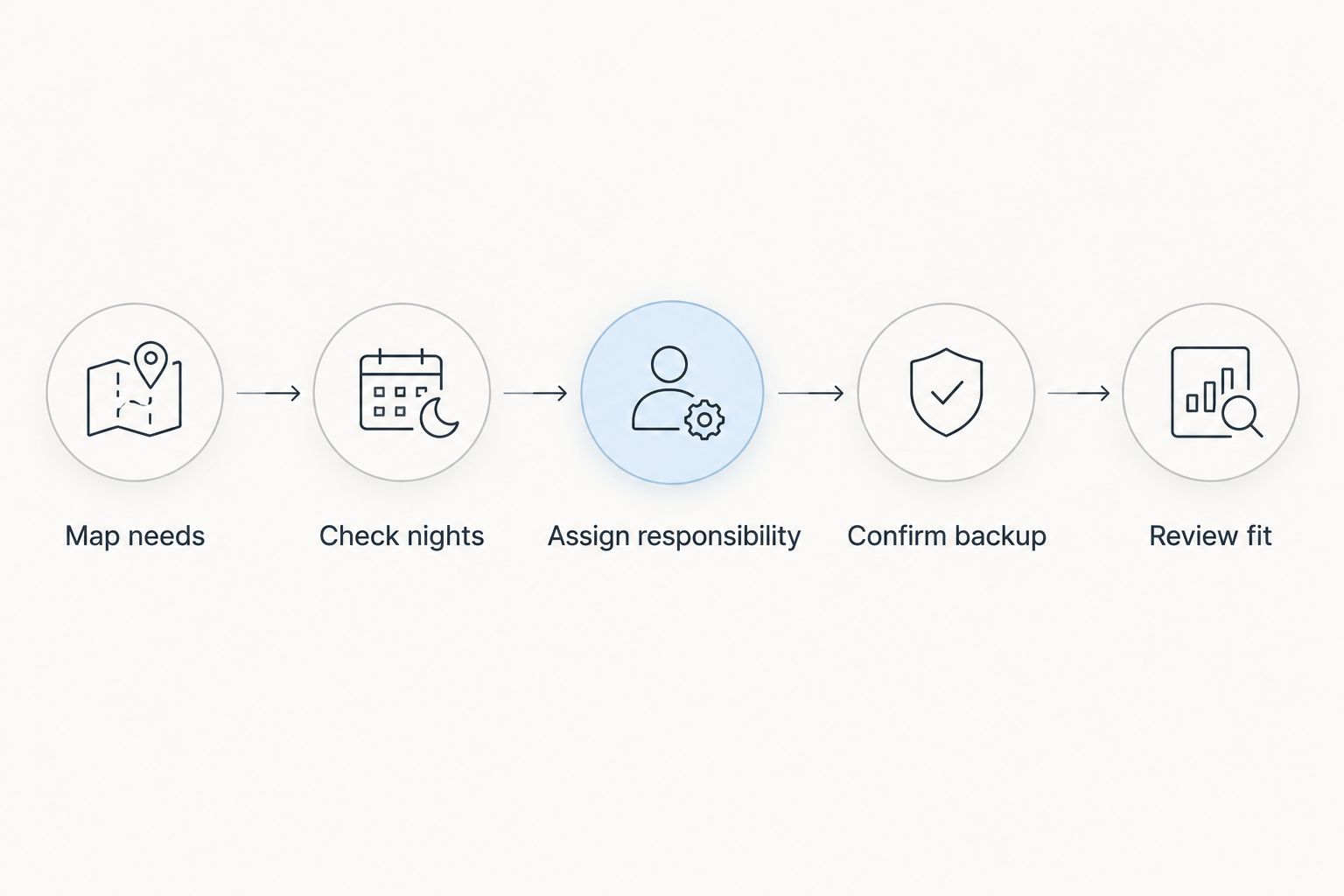
Use this sequence to turn a broad search for live-in home care services into a workable decision. Keep the checklist beside you when you visit Families or speak with prospective providers.
Map needs
Use your care diary to separate personal assistance, companionship, household tasks, and clinical needs. Describe mobility support precisely, including equipment and any professional instructions already in place.
Check nights
Record what help is needed after bedtime and who currently provides it. Ask a qualified care professional to assess whether the proposed staffing arrangement matches those needs.
Assign responsibility
Name the person or organization responsible for supervision, employment administration, care-plan updates, and resolving concerns. Avoid shared responsibility that leaves nobody accountable.
Confirm backup
Walk through sickness, leave, a missed arrival, and a placement ending. Ask who responds, how the household is notified, and what care is available while a replacement is arranged.
Review fit
Discuss communication preferences, privacy, language needs, pets, household routines, and personal boundaries. Set a recommended 30-day review to revisit the arrangement, with earlier action whenever safety or needs change.
A strong agreement answers ordinary household questions as well as care questions. Confirm who buys groceries, what transport duties are included, and how family requests reach the caregiver without conflicting instructions.
Questions to resolve before signing in 2026
Use concrete scenarios rather than asking whether a provider offers good care:
- What happens if the caregiver becomes ill during the placement?
- Who assists your relative while the caregiver rests or takes time off?
- Which tasks are outside the caregiver's role?
- Who reviews a change in mobility, cognition, or nighttime needs?
- What records are kept, and who can access them appropriately?
- How do you raise a concern or request a different caregiver?
- What happens if the household needs to end the arrangement?
Ask for the contract and care plan together. If one document promises coverage that the other excludes, resolve the conflict before signing.
How the options are ranked
The 2026 ranking prioritizes clear accountability, care-task fit, overnight suitability, and workable backup arrangements. Agency-managed live-in care takes the default position because it gives households a route to provider oversight when that responsibility is included in the agreement.
Direct hiring moves ahead when a household wants control and can manage employment. Awake shift-based care becomes the first choice when the assessed need is continuous overnight attention. These are decision criteria, not provider inspection scores or claimed testing results.
Which live-in home care services should you choose?
Start with agency-managed live-in care if you want help managing the arrangement. Compare written responsibilities before comparing provider promises.
Choose direct hiring only when someone accepts the management role. Choose awake shift-based care when overnight needs require it, even if your original search was for a resident caregiver.
For a 2026 decision, the deciding document is the coverage plan. It should show who does what, when they do it, and what happens when the usual arrangement fails.
FAQ
What's the best type of live-in home care service?
Agency-managed live-in care is the default starting point for households seeking provider oversight. Confirm that assessment, supervision, and replacement responsibilities are included in the agreement.
Does live-in care mean someone is awake all night?
No. A caregiver living in the home does not automatically provide continuous awake coverage. Ask for written working hours, rest arrangements, and overnight responsibilities.
Is directly hiring a live-in caregiver better than using an agency?
Direct hiring fits households prepared to manage the employment relationship; agency-managed care fits households seeking provider oversight. The better choice depends on who will supervise care and arrange backup.
Can a live-in caregiver provide nursing care?
Do not assume a live-in caregiver can perform nursing tasks. Confirm the person's qualifications, permitted duties, and any clinical arrangements with an appropriate licensed professional.
What should I ask about overnight care?
Ask who remains responsible while the live-in caregiver rests and what happens when help is needed overnight. Describe actual nighttime tasks so the proposed arrangement can be assessed against them.
What happens when a live-in caregiver takes time off?
The care agreement should identify who arranges and provides coverage during time off. Confirm the process before placement rather than assuming an agency or family member will step in.
How should I use Families when comparing home care?
Use Families as a starting point for your research, then assess prospective providers against your relative's care needs. Make the final choice from a written care plan, clear responsibilities, and confirmed coverage arrangements.
One last thing
Ask this before agreeing to any placement: Who helps your relative while the caregiver is resting? A clear answer exposes the difference between someone living in the house and a care arrangement that covers the help your relative actually needs.
This guide supports care planning, not an individual clinical assessment or legal advice. Involve qualified professionals when health needs, safe care tasks, or employment responsibilities require them.