
Best overall: a dementia-focused home care agency with documented training and backup coverage; best for continuity: a directly hired caregiver; best for medical needs: clinician-directed home health. This 2026 guide compares provider models for in home dementia caregivers, including respite support, so you can match the arrangement to your relative’s needs rather than choose by a company name alone.
- For in home dementia caregivers, prioritize documented dementia training, a written care plan, and dependable backup coverage.
- A dementia-focused agency is the default shortlist choice when your family needs supervision and replacement caregivers.
- A directly hired caregiver suits families prepared to manage hiring, scheduling, and absences.
- Clinician-directed home health addresses skilled medical needs; respite support gives family caregivers planned relief.
Why this matters
Dementia care involves more than assigning someone to stay in the house. You need a caregiver who understands your relative’s communication, routines, distress signals, and safety needs—and knows when to contact you or a clinician.
For families comparing in home dementia caregivers through Families, the best default is an agency that can document dementia training, supervision, and replacement coverage. Those conditions matter more than a broad promise of compassionate care.
This ranking compares care arrangements, not individual businesses. Use it to decide which kind of provider to interview, then verify the people and services offered in your location.
What makes the best in-home dementia care provider?
Use these criteria before you compare names. A strong answer describes a process and identifies who is responsible; a weak answer stops at reassurance.
- Dementia-specific preparation: Ask how caregivers learn to respond to confusion, repeated questions, resistance to personal care, and distress.
- Caregiver continuity: Find out who normally attends, how introductions work, and how substitutes receive the care plan.
- Supervision and escalation: Identify the person who reviews concerns and the procedure for contacting a clinician or emergency services.
- Backup coverage: Ask what happens when the assigned caregiver is absent, including outside office hours.
- Scope of care: Separate companionship and personal care from skilled nursing, therapy, and other clinical services.
- Family communication: Require a clear handoff covering changes in behavior, eating, mobility, sleep, and completed care tasks.
For your 2026 shortlist, request examples of these procedures before committing to recurring visits. A provider’s category is only the starting point; its actual staffing and operating practices determine the fit.
In-home dementia care options at a glance
| Rank and provider model | Best for | Standout feature to verify | Key limitation |
|---|---|---|---|
| 1. Dementia-focused home care agency | Recurring personal care with staffing oversight | Documented training, supervision, and replacement process | An agency name does not guarantee consistent caregivers |
| 2. Directly hired caregiver | Continuity with a familiar person | Relevant experience and a workable long-term schedule | The family must arrange management and backup |
| 3. Clinician-directed home health | Skilled medical care at home | Services matched to a clinician’s assessment and plan | Clinical visits do not automatically cover ongoing supervision |
| 4. Respite care provider | Planned relief for a family caregiver | A clear handoff and coverage for the agreed period | Occasional visits require deliberate familiarization |
These arrangements can work together. For example, a person receiving skilled nursing visits can still need a separate caregiver for meals, dressing, or supervision between visits.
1. Dementia-focused home care agency: best for recurring support
A home care agency arranges caregivers for agreed household, companionship, or personal-care tasks. For dementia care, ask the agency to explain its training, matching, supervision, and replacement procedures rather than assume the word dementia describes a specialist service.
Best for: Families seeking recurring support without personally managing every staffing decision.
Dementia-focused home care agency pros
- A verified replacement process gives you a route to address caregiver absences.
- A named supervisor gives the family someone accountable for care concerns.
- Shared care notes can support handoffs when more than one caregiver attends.
Dementia-focused home care agency cons
- Staffing changes can interrupt familiarity and established routines.
- Agency-level training claims do not establish the assigned caregiver’s experience.
- Personal-care services do not automatically include skilled medical care.
Ask who will attend the first visit and whether you can meet that person beforehand. Then describe a real situation: your relative refuses a shower, repeatedly asks to leave, or becomes frightened during dressing. Listen for an approach that respects the person, reduces distress, and follows an agreed escalation plan.
Request 2 references from families with relevant care needs, subject to their consent. Ask about reliability, communication, and how the agency handled a problem—not just whether the caregiver was pleasant.
Verdict: Buy only after the agency documents its training, supervision, and backup arrangements.
2. Directly hired caregiver: best for personal continuity
A directly hired caregiver works under an arrangement you establish with that individual. This model puts the relationship at the center, but it also leaves your family responsible for defining duties, managing the schedule, and arranging cover.
Best for: Families able to manage employment or contracting responsibilities and maintain a separate backup plan.
Directly hired caregiver pros
- You interview the person who will provide care, not only a coordinator.
- A stable arrangement supports familiarity with preferences and household routines.
- You can discuss daily expectations directly with the caregiver.
Directly hired caregiver cons
- Illness, leave, or departure creates a coverage problem for the family.
- References and relevant experience require direct verification.
- Employment, tax, insurance, and worker-classification responsibilities need local professional guidance.
Ask candidates to describe their own role in previous dementia-care work. Separate first-hand experience from general familiarity with older adults. Discuss boundaries around lifting, medications, transportation, personal care, and emergency decisions before anyone starts.
Do not build the entire plan around one person’s availability. Identify a substitute, explain how that person will receive instructions, and decide who takes over if neither caregiver can attend.
For Families readers prioritizing a familiar face, direct hiring belongs on the shortlist only when continuity includes a credible absence plan.
Verdict: Buy if you can manage the arrangement and secure backup; skip if you need someone else to own staffing.
3. Clinician-directed home health: best for skilled medical needs
Home health addresses assessed clinical needs through services such as nursing or therapy, depending on the care plan and provider. It is not interchangeable with ongoing companionship, personal care, or supervision.
Best for: People whose care requires skilled assessment or treatment at home under appropriate clinical direction.
Clinician-directed home health pros
- Clinical services address needs outside a nonmedical caregiver’s role.
- A care plan defines the purpose of skilled visits.
- Clinicians can identify concerns that require medical follow-up.
Clinician-directed home health cons
- Scheduled visits leave periods when other support is still needed.
- Access, eligibility, and covered services depend on the arrangement and applicable requirements.
- Different professionals can attend for different clinical tasks.
Start with your relative’s treating clinician when the need involves wound care, rehabilitation, a significant health change, or another clinical concern. Ask which tasks require licensed professionals and which can be handled through personal care.
For your 2026 care plan, write these responsibilities separately. A nurse’s visit does not answer who helps with dinner, responds to distress later that evening, or stays while a family member is away.
Seek urgent medical help for a sudden or severe change rather than treating every new behavior as an expected part of dementia.
Verdict: Buy for an assessed clinical need; skip as a substitute for ongoing daily supervision.
4. Respite care provider: best for family caregiver relief
Respite describes temporary replacement care that gives the usual caregiver a break. At-home respite can be arranged through an agency or another suitable caregiver, so this category describes the purpose of care rather than a distinct professional qualification.
Best for: Families needing planned relief while maintaining care at home.
Respite care provider pros
- You can define coverage around a specific absence or recurring break.
- A written handoff makes the temporary caregiver’s responsibilities clear.
- Repeat visits can establish a familiar relief caregiver.
Respite care provider cons
- An unfamiliar person needs preparation before taking over.
- Occasional coverage does not solve every recurring care need.
- A respite label does not establish dementia training or medical capability.
Arrange an introductory visit while a familiar person is present. Explain how your relative communicates discomfort, which activities feel reassuring, and what the caregiver should do if a routine is refused.
Agree on contact instructions and the circumstances that require you to return. Avoid leaving the substitute to improvise medication responsibilities, mobility assistance, or decisions about leaving the house.
Respite works best as a defined handoff, not an assumption that any available caregiver can step into the household without preparation.
Verdict: Buy for a planned break after a supported introduction and a clear handoff.
How this ranking works
The ranking prioritizes dementia preparation, continuity, supervision, backup coverage, scope, and communication. An agency takes the default position because families seeking recurring help should first assess an arrangement that can assign responsibility for staffing and oversight.
That position is conditional, not a quality guarantee. A directly hired caregiver with verified experience and dependable backup can fit your household better than an agency that cannot explain who will attend.
Families is a starting point for your search, not a substitute for checking the assigned caregiver. Apply the same questions to every candidate on your 2026 shortlist.
Turn interviews into a workable care plan
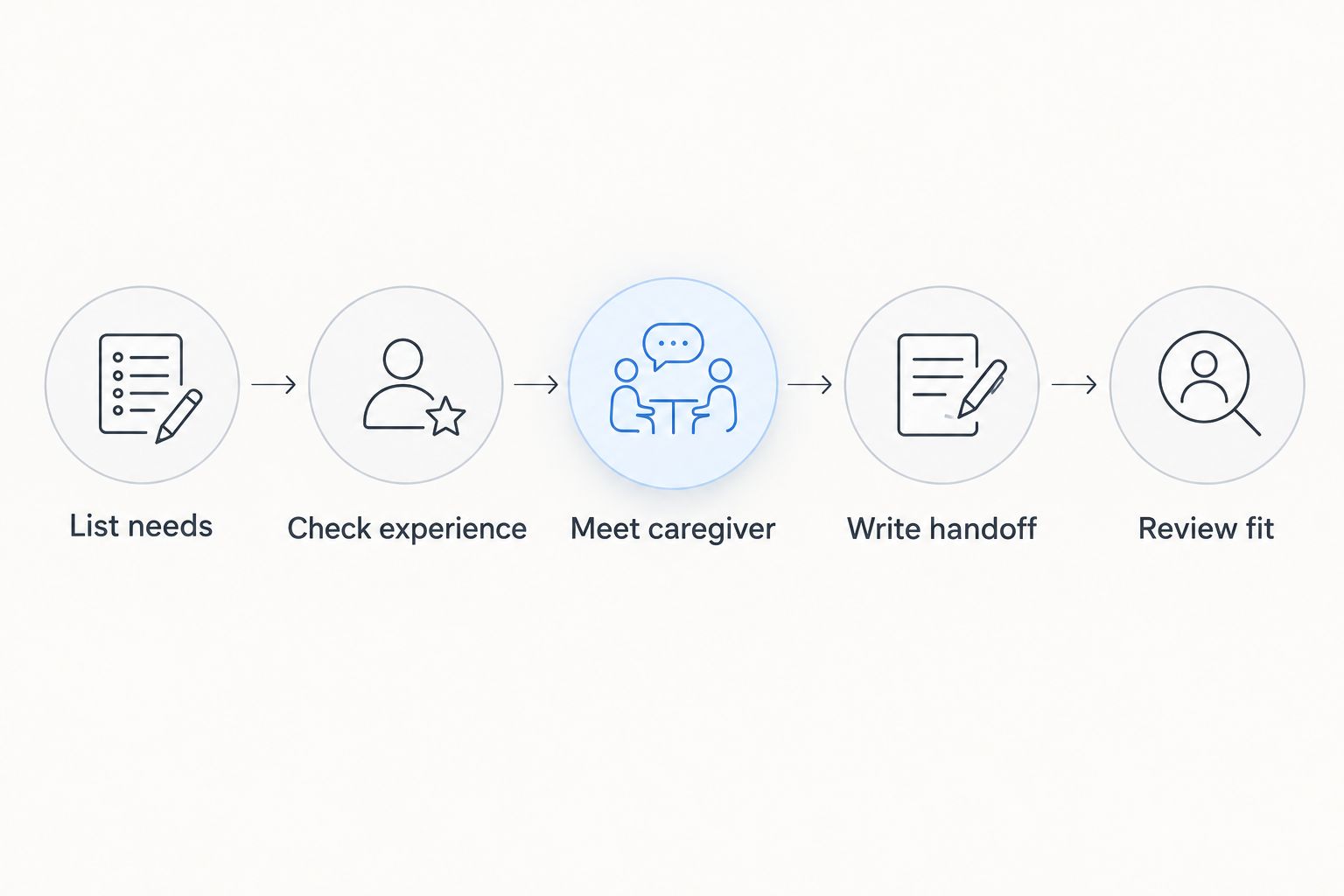
A good interview ends with written responsibilities. Use this sequence before the first unaccompanied visit:
- List needs: Separate companionship, personal care, household tasks, supervision, and clinical care.
- Check experience: Discuss relevant situations and verify references and any required credentials.
- Meet caregiver: Introduce the person who will actually attend, using a familiar activity where possible.
- Write handoff: Create a 1-page summary of routines, communication preferences, contacts, and agreed responsibilities.
- Review fit: Review the first 7 days of care, or sooner if concerns arise, and correct gaps promptly.
Keep detailed clinical instructions in the appropriate care documents rather than squeezing everything into the summary. The short handoff should help a substitute find essential information, not replace professional guidance.
For Families readers, the decisive question is practical: can the named caregiver explain what to do during an ordinary visit and what to do when that visit stops being ordinary?
Which in-home dementia care provider should you choose?
Choose a dementia-focused agency as your default interview route if you need recurring help and want a provider responsible for staffing. Confirm that responsibility in writing; do not infer it from the agency’s size or name.
Choose direct hiring when you can manage the arrangement. Add clinician-directed home health for assessed medical needs, and use respite when the immediate goal is relief for the usual caregiver.
Your best 2026 choice is the arrangement that covers the actual week: ordinary visits, absences, handoffs, and changes in need. Reject any proposal that leaves a critical responsibility unassigned.
FAQ
What's the best type of in home dementia caregiver?
A dementia-focused agency is the default shortlist choice when you need recurring care, staffing oversight, and replacement coverage. Verify those services with the actual provider; the agency label alone does not establish them.
Is a private caregiver better than a home care agency?
A private caregiver fits families able to manage hiring, scheduling, and backup themselves. An agency fits families seeking an organization responsible for those functions, provided that responsibility is explicit.
Do in-home dementia caregivers provide medical care?
Nonmedical caregivers are not a substitute for licensed clinical care. Ask the treating clinician which tasks require a qualified medical professional, and confirm each provider's permitted scope.
What should I ask before hiring a dementia caregiver?
Ask about dementia experience, references, supervision, absences, care notes, and responses to distress. Discuss a real situation from your household and request a specific explanation of how the caregiver would respond.
Can home health replace a caregiver who stays with my parent?
Home health does not automatically replace ongoing supervision or personal care. Clarify what each clinical visit covers and arrange support for needs outside those visits.
How do I prepare for the first respite visit?
Introduce the respite caregiver while a familiar person is present and provide a written handoff. Explain routines, communication preferences, contact instructions, and the limits of the caregiver's responsibilities.
When should I review the dementia care arrangement?
Review the arrangement after the first visits and whenever needs, caregivers, or schedules change. Address missed tasks, distress, communication failures, or uncovered absences rather than waiting for a routine review.
One last thing
Ask the provider to walk through an absence before you hire. Who calls you, who comes instead, and how does that person learn the routine?
That question turns a general promise of reliability into a concrete plan. Keep Families on your research list, but make the final decision about the named caregiver, the written responsibilities, and the backup you can actually use.